




Venturi Injector vs. Bubble Diffuser: Maximizing Dissolved Ozone Efficiency in Water Systems
Venturi Injector vs. Bubble Diffuser: Maximizing Dissolved Ozone Efficiency in Water Systems
When designing or upgrading an industrial ozone water treatment system, one of the most critical engineering decisions is how to dissolve ozone gas into water effectively. Ozone (O3) has a relatively low solubility compared to oxygen, meaning that poor mass transfer leads directly to wasted energy, off-gas emissions, and underperforming disinfection or oxidation.
For system integrators, water treatment contractors, and plant engineers, the choice typically comes down to two primary gas-liquid contactors: Venturi Injectors and Bubble Diffusers.
This guide provides a direct, engineering-level comparison of venturi vs bubble diffuser ozone performance, mass transfer efficiency, and application suitability to help you optimize your next system build.
1. How Each Ozone Gas-Liquid Contactor Works
Venturi Injector (Differential Pressure Injection)
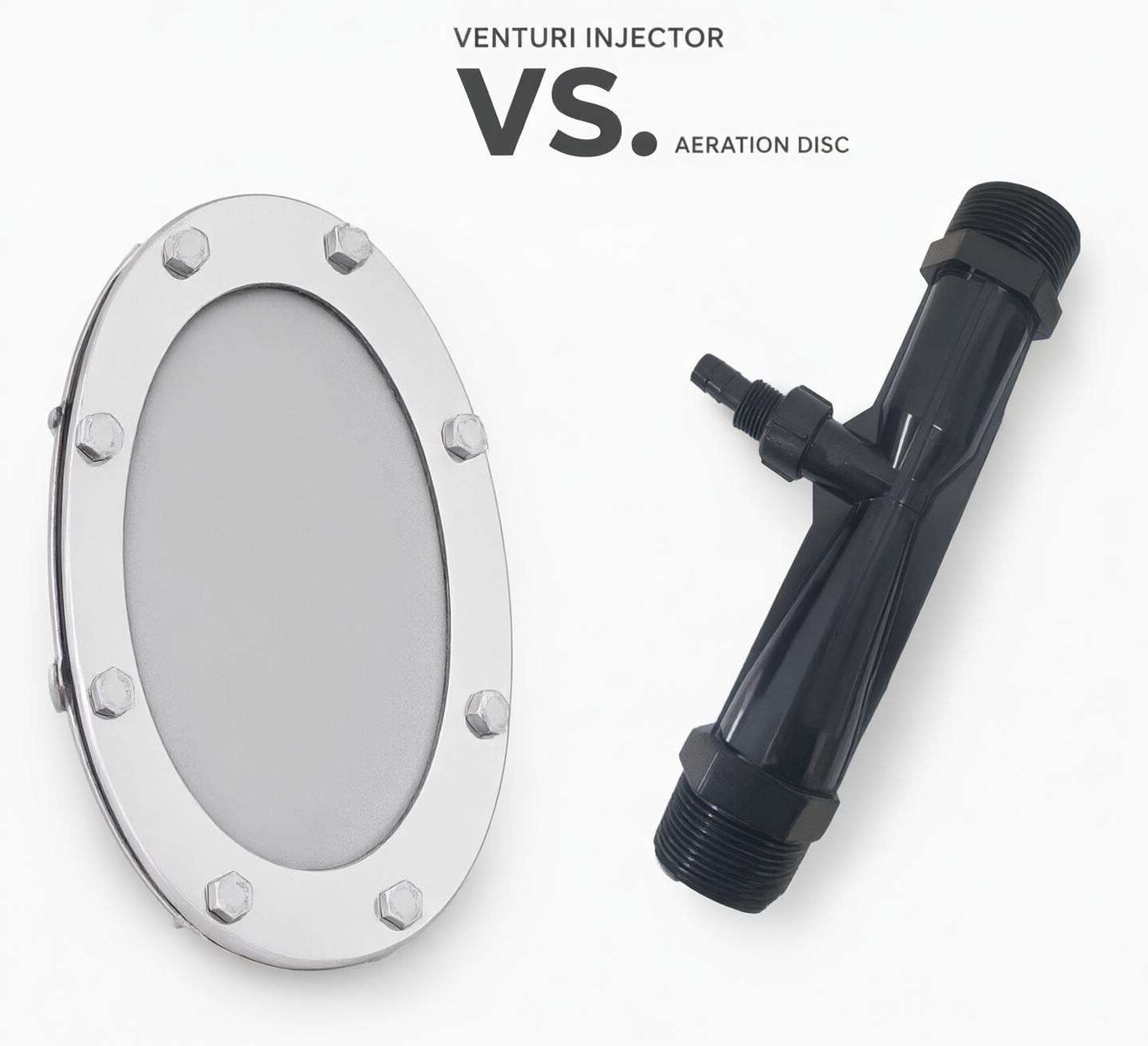
A Venturi injector operates on the Bernoulli principle. As pressurized water flows through a constricted throat (the venturi), a localized pressure drop creates a vacuum, drawing ozone gas directly into the water stream and shearing it into microscopic micro-bubbles.
- Mechanism: High-speed fluid shearing + pressure differential.
- Key Advantage: Rapid, high-rate dissolution and immediate mixing within a compact pipeline footprint.
Bubble Diffuser (Fine Bubble Diffusion)
Bubble diffusers (ceramic, stone, or perforated membrane discs/tubes) are installed at the bottom of an open or closed contact tank. Ozone gas is blown through the diffuser pores, creating rising bubbles that transfer ozone into the water column over time.
- Mechanism: Gravity-defying buoyant rise + bubble contact time.
- Key Advantage: Simple gravity-fed operation with minimal pressure drop on the water line.
2. Head-to-Head Comparison Table
| Performance Parameter | Venturi Injector | Bubble Diffuser |
| Mass Transfer Efficiency | Very High (typically 85% – 95% with a contact column) | Moderate (typically 50% – 75% depending on depth) |
| Footprint / Space Required | Compact (inline installation; saves floor space) | Large (requires a dedicated deep contact tank) |
| Energy Consumption | Requires a booster pump for pressure differential | Requires an oil-free ozone gas compressor/blower |
| Maintenance & Scaling | Low risk of clogging (high-velocity self-cleaning) | Moderate risk of biofilm growth or mineral scaling on pores |
| Best Suited For | High-flow industrial wastewater, bottled water, aquaculture | Large municipal plants, large-volume raw water reservoirs |
3. Key Factors for System Design and Selection
Maximizing Dissolved Ozone Efficiency Mixing
To achieve high dissolved ozone efficiency mixing, mass transfer is governed by surface area and contact time.
- Venturi Systems: Because a venturi creates micro-bubbles (often under 100 microns), the interfacial surface area per unit volume of gas is massive. When paired with a static mixer or a pressurized reaction column, ozone transfer happens almost instantaneously. This makes venturi systems ideal for high-concentration industrial applications where off-gas must be minimized.
- Diffuser Systems: Diffusers rely heavily on tank depth. Deeper tanks (usually 4 to 6 meters) increase hydrostatic pressure, enhancing gas absorption. However, if the tank is too shallow, bubbles reach the surface too quickly, lowering overall efficiency and increasing ozone off-gas volumes that require destruction units.
Cost and Integration
- CapEx (Capital Expenditure): Diffuser systems require larger concrete or stainless steel contact tanks, adding civil construction costs. Venturi systems require careful hydraulic design and a reliable booster pump, but save significantly on physical space.
- OpEx (Operational Expenditure): Venturi systems consume power via the water pump, while diffusers require dry, oil-free gas feed blowers. In high-output industrial settings, maximizing transfer via a venturi reduces the overall ozone generator capacity required, saving electrical power over the system's lifecycle.
4. Which One Should You Choose?
- Choose a Venturi Injector if: You are building a skid-mounted system, treating high-flow industrial wastewater, working with limited floor space, or requiring high dissolved ozone concentrations for heavy oxidation (e.g., COD removal, pharmaceutical intermediates, or high-throughput bottling lines).
- Choose a Bubble Diffuser if: You are managing large municipal drinking water treatment plants with deep basin infrastructure where continuous, low-pressure off-line diffusion is standard practice.
Partner with Industrial Ozone Experts
Selecting the correct ozone gas liquid contactor and matching it with the right high-output industrial ozone generator is critical to the long-term reliability of your water treatment project.
Whether you need standalone venturi injection assemblies, high-efficiency mixing skids, or a complete industrial ozone generation system tailored to your water flow rate and target ppm, our engineering team is here to support your project.
Need technical specifications, or custom configuration support for your upcoming project?
Contact our engineering team today or request a quote for our industrial ozone equipment and matching accessories.
Tags:
Related Posts