




Complete Guide: Well Water Treatment for Iron, Manganese & Hydrogen Sulfide Removal via Ozone
Complete Guide: Well Water Treatment for Iron, Manganese & Hydrogen Sulfide Removal via Ozone
If you operate a rural manufacturing facility, agricultural farm, commercial greenhouse, or rural resort supplied by a private well, you are likely familiar with the headaches caused by untreated well water.
Water that looks clear when first pumped from the ground can quickly turn cloudy, stain laundry a stubborn reddish-brown, clog expensive piping networks, or—worst of all—release an overpowering rotten egg smell.
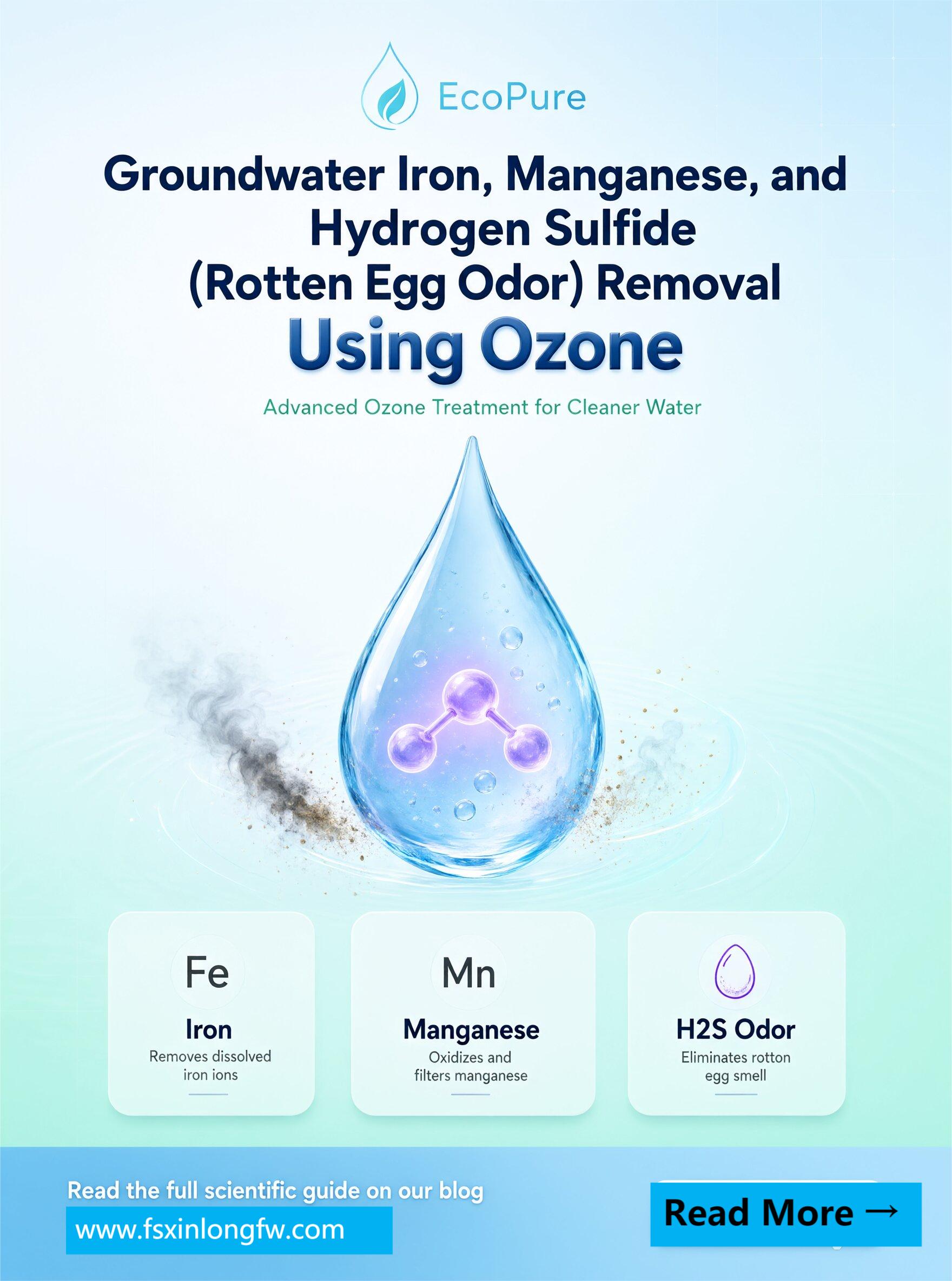
These common water quality issues are caused by three notorious culprits: dissolved iron, manganese, and hydrogen sulfide (H2S).
While traditional methods like chemical chlorine dosing or greensand filters have been used for decades, they come with high ongoing operating costs, chemical handling hazards, and constant media replacement. Today, plant managers and facility operators are shifting toward a cleaner, more efficient, and chemical-free solution: advanced ozone oxidation.
The Culprits: Why Your Well Water Smells, Stains, and Clogs
Before looking at the treatment solution, it helps to understand what is happening beneath the surface:
- Hydrogen Sulfide (H2S) – The Rotten Egg Smell: Even in trace amounts (as low as 0.5 ppm), dissolved hydrogen sulfide gas gives well water a distinct, repulsive sulfur odor. Beyond the smell, it is corrosive to metal plumbing and industrial equipment.
- Dissolved Iron (Fe^2+): In the oxygen-depleted environment of deep groundwater, iron stays dissolved. Once exposed to air or pressure, it oxidizes into rust particles, leaving red/brown stains on fixtures, scaling up pipes, and imparting a metallic taste.
- Manganese (Mn^2+): Often found alongside iron, dissolved manganese causes dark brown or black stains, fouls industrial RO membranes, and leaves bitter-tasting deposits in commercial water lines.
Why Choose Ozone for Well Water Treatment?
Ozone (O3) is one of the most powerful commercially available oxidizers in the world. When introduced into untreated well water via a specialized contact tank and Venturi injector system, ozone rapidly destroys contaminants through powerful oxidation without adding harsh chemicals like chlorine.
Here is why well water ozone iron manganese treatment systems are becoming the gold standard for industrial and commercial applications:
- Instant Chemical-Free Oxidation: Ozone immediately converts soluble ferrous iron and manganese into insoluble solid oxides, which can then be easily filtered out using a standard multi-media or pressure sand filter.
- Complete Elimination of Sulfur Odor: Ozone directly attacks and neutralizes hydrogen sulfide molecules, oxidizing them into harmless sulfates and completely eliminating the rotten egg smell well water ozone is famous for solving.
- No Chemical Residue or Harmful Byproducts: Unlike chlorine—which can create trihalomethanes (THMs) when reacting with organic matter—ozone simply reverts back to pure oxygen (O2) after doing its job, leaving zero chemical footprint.
- Disinfection and Biofilm Control: Alongside mineral oxidation, ozone is a potent broad-spectrum disinfectant. It destroys iron bacteria, sulfur-reducing bacteria (which often worsen the rotten egg smell), algae, and pathogens in a single step.
Engineering Note: For high-flow commercial and industrial operations, selecting the correct hydrogen sulfide removal ozone system requires precise water chemistry testing (calculating pH, dissolved oxygen, and peak flow rates). Contact our engineering team for a customized system configuration.
Typical Ozone Treatment Process Flow
A reliable, automated well-water treatment plant utilizing industrial ozone typically follows a 4-stage process:
- Raw Water Extraction & Pre-Filtering: Raw well water is pumped through a coarse screen or disc filter to catch large particulate sand and grit.
- Ozone Injection & Mixing: An industrial-grade ozone generator feeds ozone gas into the water stream using a high-efficiency Venturi injector, followed by a retention contact tank to ensure complete reaction time.
- Multi-Media Filtration: The oxidized iron and manganese particles precipitate out of the solution and are caught by a backwashing multi-media depth filter, producing crystal-clear effluent.
- Post-Treatment Polishing (Optional): Depending on end-use requirements (e.g., bottled water, food processing, or sensitive manufacturing), an activated carbon filter polishes the water to remove any residual trace gases.
Upgrade Your Well Water System Today
Dealing with stubborn iron stains, manganese buildup, or a persistent rotten egg sulfur smell can severely impact your industrial productivity, equipment lifespan, and product quality. Upgrading to an automated, heavy-duty industrial ozone system provides a reliable, low-maintenance, and eco-friendly long-term fix.
- Need a custom flow-rate calculation or engineering schematic for your facility?
- Looking for factory-direct wholesale pricing on industrial ozone generators and skid-mounted treatment systems?
👉 [Explore Our Industrial Ozone Generators & Water Treatment Systems Catalog]
💬 [Chat Directly with Our Technical Sales Engineers on WhatsApp]
✉️ [Contact us & Custom Quote Today]
Tags:
Related Posts