




Gas-Liquid Mixing Pumps for Ozone: Achieving 90%+ Dissolution Efficiency
Gas-Liquid Mixing Pumps: Microbubble Generation for High-Efficiency Dissolved Ozone
If you are integrating an industrial ozone system, generating the gas is only half the battle. You can invest in a high-concentration ozone generator, but if that gas simply bubbles to the surface and escapes through your off-gas destructor, your treatment efficiency—and your client’s budget—goes right out the vent.
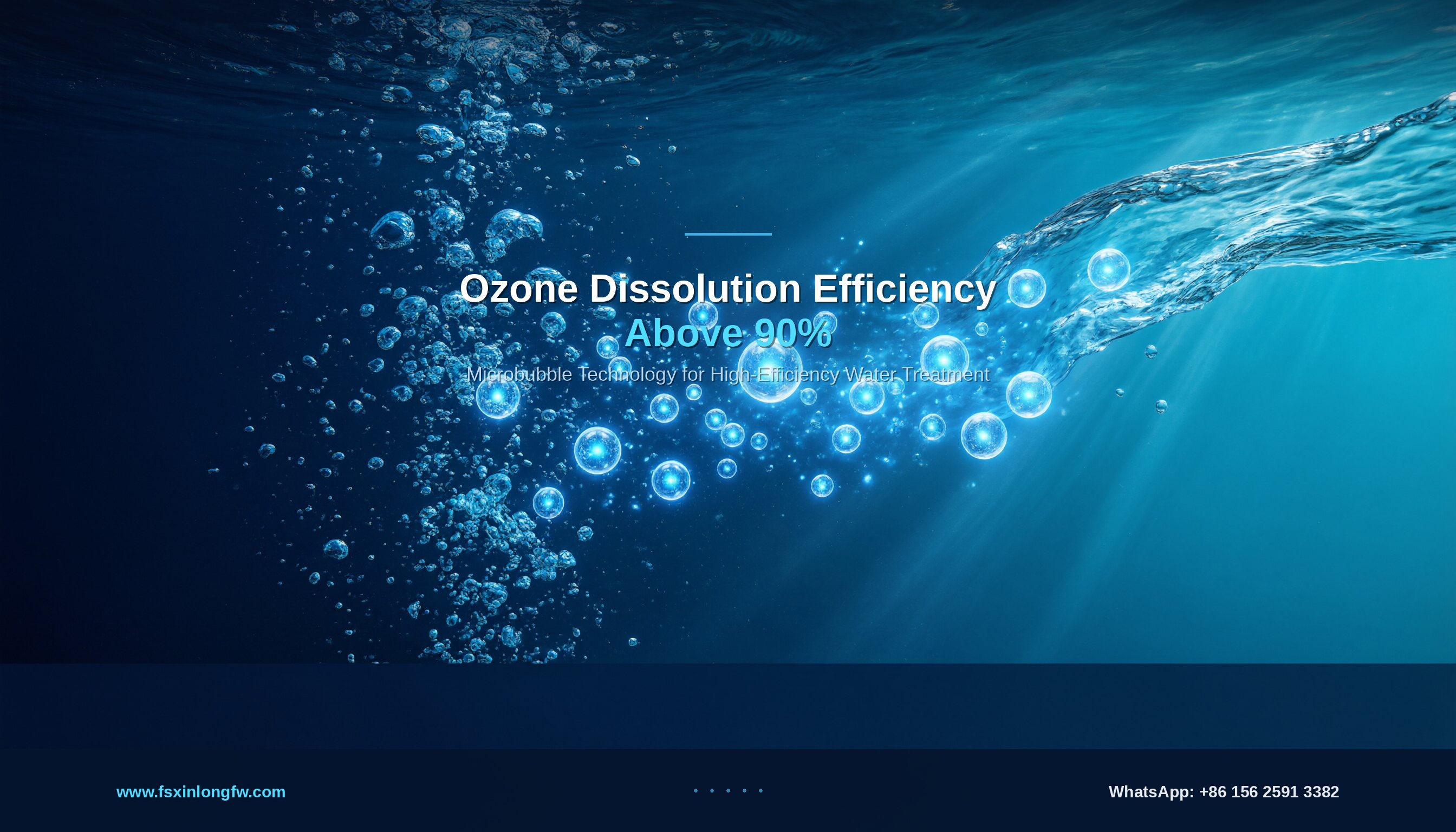
For system integrators and water treatment engineers, mass transfer is usually the biggest bottleneck. Traditional coarse-bubble diffusers often leave you stuck at 40% to 60% dissolution efficiency. Switching to a gas-liquid mixing pump for ozone changes the fluid dynamics entirely, routinely pushing dissolved ozone transfer rates above 90%.
Here is how microbubble generation works at the hardware level, how it compares to standard Venturi setups, and what to look for when sizing a dissolved ozone mixing pump for continuous industrial operation.
Why Traditional Ozone Diffusion Wastes Gas
Ozone (O3) is inherently unstable in water and only sparingly soluble compared to chlorine. When you inject ozone through a standard porous stone or coarse diffuser, it forms large bubbles (typically 2 to 5 millimeters in diameter).
Large bubbles have two major drawbacks in a contact tank:
- Low Surface-Area-to-Volume Ratio: Gas transfer only happens at the boundary layer between the bubble and the water. Large bubbles hold a lot of gas inside that never touches the liquid before reaching the surface.
- High Buoyancy: Large bubbles rise rapidly. Within seconds, they break the surface and enter the headspace, forcing your ozone destruct unit to work overtime while leaving your dissolved ozone concentration (measured in mg/L or ppm) lower than required.
How a Microbubble Generator Pump Solves Mass Transfer
A microbubble generator pump for ozone—often called a gas-liquid mixing pump or multiphase pump—eliminates the need for separate booster pumps, complex Venturi manifolds, and massive contact towers.
Instead of mixing gas and water passively in a pipe, the pump pulls both water and ozone gas directly into the pump casing simultaneously:
- Negative Pressure Suction: The impeller rotation creates a vacuum at the suction port, drawing ozone gas directly from your generator without needing a high-pressure air compressor to force the gas in.
- High-Speed Shearing & Pressurization: Inside the pump chamber, the high-speed impeller shears the gas pockets into microscopic bubbles—typically ranging from 20 to 50 microns in diameter—while pressurizing the mixture (usually between 0.3 to 0.5 MPa).
- Instantaneous Dissolution: Because microbubbles have an exponentially larger total surface area and almost zero buoyancy, they remain suspended in the water column. Under internal pump pressure, the ozone dissolves almost instantly into the liquid phase before the water even exits the discharge pipe.
Engineering Takeaway: By shrinking bubble size from millimeters to microns, you increase the gas-liquid contact surface area by more than 100 times, turning a slow diffusion process into near-instantaneous saturation.
Gas-Liquid Mixing Pump vs. Venturi Injector: Which Should You Specify?
System integrators often debate between sticking with a traditional Venturi injector + booster pump setup or moving to an integrated gas-liquid mixing pump. Both have their place, depending on flow rate and piping constraints.
| Feature / Parameter | Gas-Liquid Mixing Pump (Microbubble) | Venturi Injector + Booster Pump |
| Ozone Dissolution Rate | 90% – 95%+ | 65% – 80% (requires static mixer) |
| Bubble Size | 20 – 50 microns (milky white water) | 200 – 1,000 microns |
| System Footprint | Compact (single unit replaces pump + mixer) | Larger (requires bypass loop & contact tank) |
| Gas-to-Liquid Ratio | Handles up to 8% – 10% gas volume | Typically drops efficiency above 5% gas |
| Backpressure Tolerance | High (maintains stable suction under load) | Sensitive to downstream pressure drops |
| Best Use Case | High-concentration oxidation, tight spaces, retrofit skids | Low-demand sanitation, simple irrigation loops |
If your project requires strict dissolved ozone residuals—such as high-COD industrial wastewater, recirculating aquaculture systems (RAS), or bottled water CIP lines—a dissolved ozone mixing pump reduces your required ozone generator capacity by up to 25% simply because less gas is wasted.
4 Hardware Specs to Check Before Ordering
Not every centrifugal or multiphase pump survives prolonged exposure to dissolved ozone. When sourcing a pump for your skid or treatment plant, verify these four hardware details:
1. Wetted Material Compatibility (316L vs. 304)
Never use standard 304 stainless steel for high-concentration ozone mixing; pitting corrosion will ruin the impeller within months. Ensure the pump casing, impeller, and shaft are constructed from SUS316L stainless steel (or specialized fluoroplastics for extreme concentrations).
2. Ozone-Resistant Mechanical Seals
This is the number one failure point in field installations. Standard EPDM or Buna-N seals will crack and leak rapidly when exposed to pressurized ozone. Specify Viton (FKM) or PTFE (Teflon) mechanical seals paired with Silicon Carbide (SiC) seal faces.
3. Gas-to-Liquid Intake Ratio
Check the pump curve specifically for air/gas intake volume, not just water flow (m^3/h). If you feed too much gas into an undersized pump, it will suffer from air-binding (cavitation) and lose discharge pressure. Match your ozone generator’s gas flow rate (L/min) to 8%–10% of the pump’s rated liquid flow.
4. Inlet Check Valve Protection
A sudden power outage can cause pressurized water to backflow up the ozone gas line, destroying your ozone generator's dielectric tubes. Always install a dedicated 316L + PTFE spring check valve and a solenoid shut-off valve between the generator and the pump’s suction port.
Need Help Matching a Mixing Pump to Your Ozone Generator?
Selecting the right gas-liquid mixing pump for ozone comes down to balancing water flow rate, target dissolved ozone ppm, and backpressure. Oversizing wastes electricity; undersizing causes gas-lock and poor oxidation.
At Foshan Xinlong, we supply both commercial/industrial ozone generators and pre-matched 316L microbubble mixing skids engineered for continuous duty. Whether you are building a custom water treatment skid from scratch or upgrading an underperforming Venturi loop, our technical team can help you size the exact pump and generator pairing.
- Explore Our Industrial Ozone Generator & Mixing Systems
- Send Us Your Flow Rate & Target PPM for a Custom Sizing Quote (Contact Us)
Tags:
Related Posts